Search Engine Optimization
Search engine optimization is the process of increasing the number of visitors to your website and ensuring that your site appears high in the search results on search engines. To describe in a more simpler way, search engine optimization is to make sure that your site is structured in a way that search engine can understand.
 Google, Bing and Yahoo are the major commercial search engines that drive majority of the website traffic. Search engines are the primary method for navigation for most of the internet users even though social media and other types of traffic can generate visits. But this can only happen if your site's content, products, information, services are happily accepted by users.
There are many aspects to SEO, be it indexing keywords on your page or the way other sites link to you on the web. Search queries are of extraordinary value as they are the words that users type into the search box. Search engine traffic can make or break an organizations' business. If your site has targeted traffic then it can provide publicity, revenue and exposure like no other marketing and promotion methods.
If you ask "Can I do SEO by myself?" then I would say, the world of SEO is complex but most people easily understand the basics. There are thousands of free SEO education widely available on web including some blogs like this. Depending on your willingness to learn and the complexity of your website you can decide if you actually need an expert to handle things for you. In any case, it's always good to have a firm grasp of core concepts.
There are two kinds of SEO strategy:
- One page SEO : Practice of optimizing individual web pages in order to earn more relevant traffic and rank higher in search engines. On-Page refers to both content and HTML source code of a page that can be optimized.
- Off Page SEO : Practice of improving the position of a website in the search engine results using promotion methods - beyond website design. It refers to your sites' authority in the internet. Determined by what other websites say about your site.
On-Page Optimization Techniques
In old school SEO, on-page optimization was merely referred to keyword placement. Search engines used to like to see keywords in various locations in HTML code to help indicate the page's relevance in search query. But today this simple approach doesn't work because keyword-based algorithm may harm overall rankings as of how it impacts people's experience with your site.
Now we know that keyword stuffing is just not the way to choose! So what are the most effective way to increase your page rankings on search engines? That's what we are going to discuss below.
Here is the list of most important On-Page factors that you got to keep in mind:
1. Page Title
One of the most important factor in On-page optimization that plays a big role is your Page Title. We must make sure that we use targeted keyword phrases in the beginning of your title. Titles are the key factor that search engines use to weigh the relevance of your site and also, users tendency to click. A creative and unique title tells both search engine and users what the topic of your particular page is. If your page appears in the search result, your title will be the one that is usually displayed as the first line of the results. So including your main keywords in the title is necessary.
Now let's see what are the things that you shouldn't do while creating titles. Never try to keyword stuff your title. We should not attempt to repeat keywords in your title tag with the intention to get better ranking. The words used in search query will appear in the title as bold. This helps the users to determine if the page is relevant to their search. Make sure no two pages in your site has the same title. The limitation in character length is 65, but make sure you do not use more that 55-60 characters for page title. This is because different characters have different pixel width and the maximum available pixel width is 512.

Here is what Matt Cutts has to say about how google chooses titles for search results.
|
2. URL
The first thing that Google or any search engine crawl is our page's URL. Search engine friendly URL's are recommended because it helps in better crawling. And also short URL's always have advantage in showing up in search results, however that is not the only factor. You should aim at using targeted keywords in the beginning of your blog post/web pages' URL. Avoid using special characters, symbols, brackets etc as part of your URL. For example, site.com/keywords would perform way better than site.com/376/786/subfolder/keyword.


Here is a video on how URL structure affect page rank.
3. Headline
It is always a good practice to break up your content to smaller parts and giving appropriate headings to them is visually appealing. These heading tags are H1, H2, H3, H4 etc. H1 tags is reserved for your main page title with subsequent subheading being H2, H3, H4. Search engines use these to determine the importance of contents. Make sure to write keyword rich headlines in the order of priority. But never repeat H2 or H3 tags too many times as it is considered as negative SEO practice. And also, it is not recommended to have H1 similar to your page title, but they shouldn't be so dissimilar that it drives away user's which came into your site seeing the relevant title.

Here is what Matt Cutts has to say about repeated usage of headline tags.
4. Meta Description
Meta description is an important place to include your relevant keywords for your content, as they are displayed within the search results when your page is listed. According to the representatives of Google and Bing, a page's meta description isn't used directly in search engine ranking algorithm. It gives the crawlers an idea of what the page is about. If your meta description is not good enough, Google may use a relevant section of your page as the snippet if it does a good job in matching up with searchers' query. Words in the snippet will be in bold if there are matching keywords. A page's title may be a few words or a phrase, where as a page's meta description must be a sentence or two. Page title and meta description for one page shouldn't match with that of another page. Limit your meta description length to 160 characters.

Here is a video on Matt Cutts discussing the necessity of having meta description for every page.
5. Meta Keywords
Meta keywords are those words that you can add for each of your page. You should be adding unique and relevant keywords for each of your page/post. These must be targeted keywords for that page. Even though search engine's like Bing still prefer meta keywords, Google has made it clear that it does not use meta keywords as a criteria in ranking. Here is what google says about using meta keyword tags.
6. Body Text
When you are writing articles, make sure to break up your content into smaller chunks and paras to make it easier for people to read. And while writing these, it is important to include your keyword phrases between your contents. But never approach keyword stuffing because search engines are definitely using advanced topic modelling algorithms to analyse the relevance and quality of your content. Overuse of keywords had resulted in negative impact on rankings. A similar scenario will occur if you make spelling mistakes in your contents. So write engaging content which is comprehensive, relevant and useful as possible.

7. Images and image Alt attribute
Now lets see how to make your page attractive! Using images within your contents is a great way to make your site more visually appealing. At the same time, having images on keyword targeted page is much more wise for a lot many reasons. All your image title must be treated same as page title. For search engines, things that matter are image title, file name, surrounding text and image alt attribute. Those doing SEO must know that when an image is linked, Alt attribute is treated similar to anchor text in text link. Appearance of images makes our site more interesting and attractive. Also note, addition of big sized images will slow down your site's loading speed, as these days google considers website speed as one of the ranking factor.

8. Internal and External Links
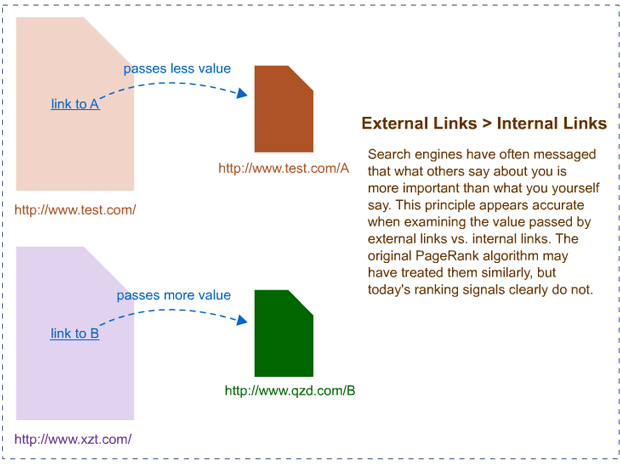
Often there is misconception that the only links that counts are those from other websites(External linking). These links are important, but these are not the only important links! Internal linking is placing your links in other pages of your website. But a good page must be accessible through not more than four internal links. Internal linking not only makes it easier for users to navigate through your site, but also ensures that your site is properly crawled allowing the search engines to find all your pages. The two main methods to improve your internal linking structure are: Content linking and permanent navigation linking.
Summary
These techniques are just some of the ways in improving your On-Page SEO. When these techniques are used individually does not make much difference to your site's ranking, but when all these techniques are used together, it help improve your site traffic. I hope these points where clear enough to start on with your page/post's on-page optimizations. Will be soon writing on Off-Page optimization as well. So stay tuned!
I also hope my previous blog on History of Google was clear enough to know the vastness of Google's ability to evolve. I will be soon writing on the major updations google carried out to become this powerful!
Please feel free to leave your comments!

No comments:
Post a Comment