Pages

Wednesday, 1 June 2016

Content optimization in SEO & How to write Quality Content

How to Work with CONTENTS


What does it mean by an "optimized content"? Content optimization is the transformation  of keyword research into live text that can influence your site’s ability to rank well in organic search results. Optimizing content is not only a matter of keyword presence or metadata, but an issue of trust,quality, intent and authority. 


Content is all about the people you want to attract. It is meant to be experienced, whether it's purpose is to entertain or to teach or to emphasize. Do not just create content for the sake of needing a traffic flow.   To know more about Content optimization in SEO & How to write Quality Content , click the link. 

Tuesday, 24 May 2016

Remarkable Google Algorithm Updations

Major Algorithm Updations Of Google


Most Important Google Updations


If you are new into blogging or fortunately became a website owner, it's necessary to be up-to-date with certain algorithm updations of Google. For search marketers with years of experience, knowing dates of these updations can help in explaining the sudden changes in their site's ranking and organic website traffic. 

Every minute, 2 million searches are made on Google and to keep such a giant search process running, Google algorithms constantly changed to ensure optimized websites. Every year, google changes its search algorithm around 500-600 times. While most of these are minor, Google occasionally brings out major updations, that affects search results in significant ways. 

In this post, I have covered all major Google algorithmic updates from past 15 years that have had biggest impact on search. 

December - 2000 Update


Update on 2000


Google launches their browser toolbar! This free browser plug-in helps internet users to search for information with Googles quick, highly relevant search from any webpage on the internet. This might not seem to you so exciting now, but back then it was definitely a huge milestone to a user friendly search engine. Along with it came ToolBar PageRank(TBPR) and that's when webmasters began to know their page rank and the Google Dance began. But now Google has officially confirmed that they wont be showing Page rank anymore but will be using internally for its ranking process. 


September  2002- 1st Documented Update


Update on 2001

There was a major shuffle in the Fall of 2002 that left many webmasters into an utter shock. They wondered "how on earth can google drop sites that were ranked in the top ten and are now on page 20. They move a toilet midstream without hinting they are going to". This was one of the webmasters' view. The details are unclear of what Google did, but it was definitely something more than the monthly Google Dance and Page Rank update. 


2003 Updates


Update on 2003

Boston was the first named Google update announced at SES Boston. Google originally aimed at a major update, so the first few updations were a combination of algorithmic changes and major index refreshes(Google Dance). It laid more emphasis on quality backlinks.

Florida update on November 2003 was the update that put updates on the map. Business owners were furious as they lost their site's ranking. Florida update was like a death knell to those low-value SEO tactics like, keyword stuffing.  


2004 Updates


Update on 2004

There were 3 updations in 2004, two of the remarkable one's being Austin and Brandy. Austin came in to clean up what Florida did. Some of the sites that weren't hit too hard by Florida update, got hit real hard on January 23 2004 by Austin updation. Google continued to crack down invisible texts and meta-tag stuffing. 

The Brandy updation on 17th-20th Feb 2004 resulted in major changes in the results of search engine. One of the founder of google Sergey Brin said that google had made 5 significant changes to its algorithmic formulas during that time. Increase in Index size, Latent Semantic Indexing(LSI), Links and Anchor texts, Neighborhoods & Downgrading of Traditional Tag-based Optimization. Google optimization then became a lot more harder than it used to be.  
  

2005 Updates


Update on 2005

Nofollow updation during Jan 2005 was to combat spam and control outbound link quality. That was when Google, Yahoo and Microsoft collectively introduced the "nofollow" attribute. Nofollow helps to clean up spammy blog comments. 

Among the many updations that took place in 2005, another remarkable one is Big Daddy updation on December 2005. Big Daddy changed the way Google handled URL canonicalization, redirects (301/302) and other technical issues.


2006 Updates


Update on 2006

Throughout 2006 Google made changes to supplemental index and how filtered pages were treated. In late 2006 they claimed that supplemental was not a penalty even if it sometimes felt that way. In December there were false alarm about an update, but google reported no major changes. 


2007 Updates

Update on 2007

Universal Search update on May 2007 saw the integration of traditional search results of google with News, Videos, Images, Local and other verticals dramatically changing their format. 

Buffy update on June 2007 may be considered as a continuation of the June 2007 Update, but it has now been given a name. The Buffy update was introduced in honor of Vanessa Fox who was leaving leaving Google. Also updated to single word search result and other small changes.


2008 Updates


                            Update on 2008

Dewey update on April 2008 saw a large scale shuffle at the end of March and into early April, but the specifics were unclear. Some suspected that Google was pushing its own internal properties including Google Books but that evidence of that was limited.

Google Suggest update on August 2008 made a major change to their logo. Google introduced Suggest to display suggested searches in a drop down below the search box as visitors typed their queries. Suggest would later go on to power Google Instant.


2009 Updates


Update on 2009


Venice update on February 2009 was a "minor change" claimed by Matt Cutts, but others felt it had long term implications.

Real-time Search update on Decemer 2009 was for real Twitter feeds, Google News, newly indexed content and a number of other sources were integrated into a real-time feed on some some SERP's. Sources continued to expand over time including social media.


2010 Updates


Update on 2010

Google Places update on April 2010 was the official launch of Google Places even-though "Places" pages were rolled out in September 2009 which was originally only a part of Google Maps. 

May Day update on May 2010 showed webmasters a significant drop in their long-tail traffic. Matt Cutts later confirmed that May Day was an algorithmic change having impact on long-tail. Sites with thin content seemed to be hit hard, foreshadowing the Panda update. 

Caffeine update on June 2010 saw the launch of Caffeine infrastructure after months of testing. Caffeine not only boosted Google's raw speed, but integrated crawling and indexing much more tightly resulting a 50% fresher index.

Google Instant update on September 2010 saw the launch of Google Instant that displayed search results while a query was being typed.

Social Signals update on December 2010 was a relatively new development in google although many SEO's had long suspected it would happen. Google and Bing confirmed that they use social signals to determine ranking, including data from Twitter and Facebook. 


2011 Updates


Update on 2011

Panda/Farmer update on 23rd February 2011 was against the growing complaint that low quality content sites were ranked higher than higher quality sites that seemed more important to users. Panda/Farmer was a major algorithm update that affected almost 12% of all search results, which include dramatic losses for some companies and immense gain for some high quality sites. Panda was intended to crack down sites that has thin content, content farms, content with very less quality and spelling mistakes. Different versions of Panda was released in the same year, 

Panda 2.0 update on 11th April 2011 was rolled out to all English queries worldwide(not limited to English speaking countries).

Panda 2.1 update on 9th May 2011 was rolled out with yet another round of changes. These changes were not discussed in detail by Google and seemed to be a minor one.

Panda 2.2 update on 21st June 2011 continued to update Panda impacted sites and data and was officially acknowledged.

Google+ update on 28th June 2011 launched a serious attack on Facebook. Google+ revolved around sharing contents around your circles and was tightly integrated into products like Gmail. Within 2 weeks Google+ reached 10M users.

Panda 2.3 update on 23rd July 2011 rolled out yet another update was unclear whether new factors were introduced or this was simply an update to Panda data and ranking factors.

Panda 2.4 update on 12th August 2011 was rolled out internationally both for English language queries globally and non-Englisg queries except for Chinese, Japanese and Korean. Google reported that this impacted upto 6-9% of queries in affected countries.

Panda 2.5 update on  28th September 2011 rolled out another Panda update. Specific details of what changed was unclear but some sites reported large-scale losses.

Freshness update on 3rd November 2011 announced that an algorithmic change providing freshness would impact up to 35% of queries( almost 3x times to that of Panda 1.0). This update affected time-sensitive results, but signaled a much stronger focus on recent content.


2012 Updates

Update1 on 2012
January 30-Pack update on 5th January 2012 is when Google announce 30 changes over their previous month including image search landing page quality detection, more relevant site-links, more rich snippets and related-query improvement. 

Venice update on 27th February 2012 was a part of their monthly update and Google code-named it "Venice". This update was to aggressively localize organic results and more tightly integrated to local search data. The exact roll out date was unclear.

Update2 on 2012
Penguin update on 24th April 2012 was yet another huge step taken by google to reward high-quality sites and reduce webspam practices. Some of the webspam activities they described were keyword stuffing, link farming and link exchange, comment spamming and guest blogging beyond a certain limit. This update impacted an estimate of 3.1% of English queries. 

Knowledge Graph update on 16th May 2012 was a major step towards semantic search. Google rolled out "Knowledge Graph", an SERP integrated display about certain places and things and facts. 

Exact Match Domain (EMD) update on 27th Sep 2012 is when google announced a change in the way it was handling exact match domains. This led to large-scale devaluation, reducing the presence of EMD's in the MozCast data set by over 10%. Official word is that this change impacted 0.6% of queries by volume.

Penguin #3 update on 5th October 2012 released a minor Penguin data update impacting 0.3% of queries, although it was suggested that next penguin update would be major.


2013 Updates

Update on 2013


Panda #25 update on 14th March 2013 was pre-announced by Matt Cutts that it would be the last panda update and this was integrated into core algorithm.

Phantom update on 9th May 2013 signaled significant traffic loss but the exact nature of this update was unknown.

Payday Loan update on 11th June 2013 announced a targeted algorithm update to take on niches with spammy results. Although this update was announced on June 11th, Matt Cutts suggested it would roll out over a 1-2 month period. 

Hummingbird update on 20th August 2013 seemed to be a core algorithm update that may power semantic search and Knowledge graph for months to come. Hummingbird was on of the google's major updation.

Authorship Shake-Up update on 19th December 2013 saw the disappearance of authorship mark-up from roughly 15% of queries over a period of about one month. The fall bottomed out around 19th but the numbers remain volatile.


2014 Updates

                            Update on 2014

Payday Loan update on 16th May 2014 was just prior to Panda 4.0 updation. It targeted spammy queries. Exact date of roll out was unclear and the back to back updates made the details difficult to sort out.

Panda 4.0 update on 19th May 2014 had confirmed a major Panda update that included both an algorithm update as well as data refresh. Officially about 7.5% of English queries were affected.

Payday Loan update on 12th June 2012 was released less than a month after the Payday Loan 2.0 and it was a major iteration. Official statements suggest that 2.0 targeted specific sites while 3.0 targeted spammy queries.

Pigeon update on 24th July 2014 shook the local SEO world with an update that dramatically altered some local results and modified how they handle and interpret location cues. Those company sites who hadn't updated their location was preferred less while ranking.

Pigeon Expands(UK,CA,AU) update on 22nd December 2014 saw the major local algorithmic update dubbed "Pigeon", expanded to Unite Kingdom, Canada, and Australia. 


2015 Updates


                              Update on 2015

Mobilegeddon update on 22nd April 2015 was a rare move that google pre-announced an algorithm update, telling us that rankings would differ for mobile friendly sites starting on 21st April. The impact of this update was short term much smaller than expected. 

The Quality update on 3rd May 2015 acknowledged a core algorithmic chance impacting "quality signals". This update have had a broad impact but Google didn't reveal any specific nature of the signals involved.

RankBrain - on 26th October 2015 revealed that machine learning had been a part of the algorithm from months contributing to the 3rd most influential ranking factor. Note that this announcement date but we believe that actual launch was closer to spring 2015. 


2016 Updates

Mobile-Friendly 2 update on May 12 2016 was released just more than a year after the original mobile-friendly update Mobilegeddon. Google rolled out another ranking signal booster to benefit mobile friendly sites on mobile search. Since the majority of sites they tracked are already mobile-friendly, its likely that the impact of the latest update was small.


Note - There is no single rhyme or reason to how Google Updates are named as claimed by Google.

Like I said earlier these are just the important updations that I have mentioned. And if you want to know more about Google from its beginning, check out my first post on History of Google.

Share if you like this post.
Please feel free to leave your comments!


Sunday, 22 May 2016

Mastering in On-Page SEO


Search Engine Optimization


Search engine optimization is the process of increasing the number of visitors to your website and ensuring that your site appears high in the search results on search engines. To describe in a more simpler way, search engine optimization is to make sure that your site is structured in a way that search engine can understand.  


search engine optimizationGoogle, Bing and Yahoo are the major commercial search engines that drive majority of the website traffic.  Search engines are the primary method for navigation for most of the internet users even though social media and other types of traffic can generate visits. But this can only happen if your site's content, products, information, services are happily accepted by users. 

There are many aspects to SEO, be it indexing keywords on your page or the way other sites link to you on the web. Search queries are of extraordinary value as they are the words that users type into the search box. Search engine traffic can make or break an organizations' business. If your site has targeted traffic then it can provide publicity, revenue and exposure like no other marketing and promotion methods.

If you ask "Can I do SEO by myself?" then I would say, the world of SEO is complex but most people easily understand the basics. There are thousands of free SEO education widely available on web including some blogs like this. Depending on your willingness to learn and the complexity of your website you can decide if you actually need an expert to handle things for you. In any case, it's always good to have a firm grasp of core concepts. 


There are two kinds of SEO strategy:
- One page SEO : Practice of optimizing individual web pages in order to earn more relevant traffic and rank higher in search engines. On-Page refers to both content and HTML source code of a page that can be optimized.

- Off Page SEO : Practice of improving the position of a website in the search engine results using promotion methods - beyond website design. It refers to your sites' authority in the internet. Determined by what other websites say about your site.


On-Page Optimization Techniques

In old school SEO, on-page optimization was merely referred to keyword placement. Search engines used to like to see keywords in various locations in HTML code to help indicate the page's relevance in search query. But today this simple approach doesn't work because keyword-based algorithm may harm overall  rankings as of how it impacts people's experience with your site.

Now we know that keyword stuffing is just not the way to choose! So what are the most effective way to increase your page rankings on search engines? That's what we are going to discuss below.


Here is the list of most important On-Page factors that you got to keep in mind:

1. Page Title

One of the most important factor in On-page optimization that plays a big role is your Page Title. We must make sure that we use targeted keyword phrases in the beginning of your title. Titles are the key factor that search engines use to weigh the relevance of your site and also, users tendency to click. A creative and unique title tells both search engine and users what the topic of your particular page is. If your page appears in the search result, your title will be the one that is usually displayed as the first line of the results. So including your main keywords in the title is necessary. 

Now let's see what are the things that you shouldn't do while creating titles. Never try to keyword stuff your title. We should not attempt to repeat keywords in your title tag with the intention to get better ranking. The words used in search query will appear in the title as bold. This helps the users to determine if the page is relevant to their search. Make sure no two pages in your site has the same title. The limitation in character length is 65, but make sure you do not use more that 55-60 characters for page title. This is because different characters have different pixel width and the maximum available pixel width is 512.


Here is what Matt Cutts has to say about how google chooses titles for search results.


2. URL

The first thing that Google or any search engine crawl is our page's URL. Search engine friendly URL's are recommended because it helps in better crawling. And also short URL's always have advantage in showing up in search results, however that is not the only factor. You should aim at using targeted keywords in the beginning of your blog post/web pages' URL. Avoid using special characters, symbols, brackets etc as part of your URL. For example, site.com/keywords would perform way better than site.com/376/786/subfolder/keyword. 
                                    Long Ugly URL
                                    Good URL

Here is a video on how URL structure affect page rank.


3. Headline

It is always a good practice to break up your content to smaller parts and giving appropriate headings to them is visually appealing. These heading tags are H1, H2, H3, H4 etc. H1 tags is reserved for your main page title with subsequent subheading being H2, H3, H4. Search engines use these to determine the importance of contents. Make sure to write keyword rich headlines in the order of priority. But never repeat H2 or H3 tags too many times as it is considered as negative SEO practice. And also, it is not recommended to have H1 similar to your page title, but they shouldn't be so dissimilar that it drives away user's which came into your site seeing the relevant title. 
                          

Here is what Matt Cutts has to say about repeated usage of headline tags.


4. Meta Description

Meta description is an important place to include your relevant keywords for your content, as they are displayed within the search results when your page is listed. According to the representatives of Google and Bing, a page's meta description isn't used directly in search engine ranking algorithm. It gives the crawlers an idea of what the page is about. If your meta description is not good enough, Google may use a relevant section of your page as the snippet if it does a good job in matching up with searchers' query. Words in the snippet will be in bold if there are matching keywords. A page's title may be a few words or a phrase, where as a page's meta description must be a sentence or two. Page title and meta description for one page shouldn't match with that of another page. Limit your meta description length to 160 characters.
                             Good and Bad Meta Description

Here is a video on Matt Cutts discussing the necessity of having meta description for every page.


5. Meta Keywords

Meta keywords are those words that you can add for each of your page. You should be adding unique and relevant keywords for each of your page/post. These must be targeted keywords for that page. Even though search engine's like Bing still prefer meta keywords, Google has made it clear that it does not use meta keywords as a criteria in ranking. Here is what google says about using meta keyword tags.


6. Body Text

When you are writing articles, make sure to break up your content into smaller chunks and paras to make it easier for people to read. And while writing these, it is important to include your keyword phrases between your contents. But never approach keyword stuffing because search engines are definitely using advanced topic modelling algorithms to analyse the relevance and quality of your content. Overuse of keywords had resulted in negative impact on rankings. A similar scenario will occur if you make spelling mistakes in your contents. So write engaging content which is comprehensive, relevant and useful as possible.
                              good and bad body text


7. Images and image Alt attribute

Now lets see how to make your page attractive! Using images within your contents is a great way to make your site more visually appealing. At the same time, having images on keyword targeted page is much more wise for a lot many reasons. All your image title must be treated same as page title. For search engines, things that matter are image title, file name, surrounding text and image alt attribute. Those doing SEO must know that when an image is linked, Alt attribute is treated similar to anchor text in text link. Appearance of images makes our site more interesting and attractive. Also note, addition of big sized images will slow down your site's loading speed, as these days google considers website speed as one of the ranking factor.

                                            
search bot looking for alt text


8. Internal and External Links

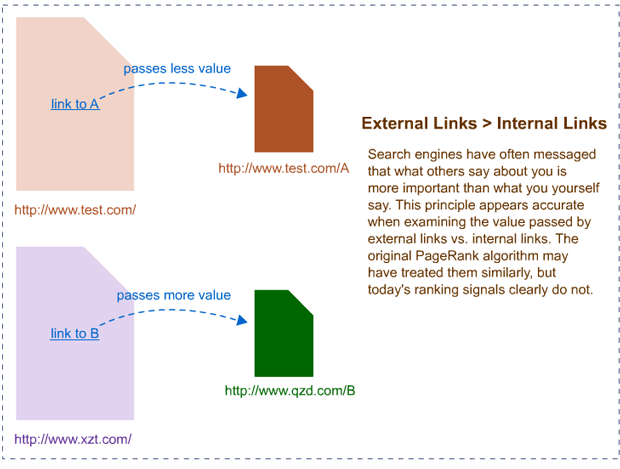
Often there is misconception that the only links that counts are those from other websites(External linking). These links are important, but these are not the only important links! Internal linking is placing your links in other pages of your website. But a good page must be accessible through not more than four internal links. Internal linking not only makes it easier for users to navigate through your site, but also ensures that your site is properly crawled allowing the search engines to find all your pages. The two main methods to improve your internal linking structure are: Content linking and permanent navigation linking.   


                      internal and external linking example


Summary

These techniques are just some of the ways in improving your On-Page SEO. When these techniques are used individually does not make much difference to your site's ranking, but when all these techniques are used together, it help improve your site traffic. I hope these points where clear enough to start on with your page/post's on-page optimizations. Will be soon writing on Off-Page optimization as well. So stay tuned!


I also hope my previous blog on History of Google was clear enough to know the vastness of Google's ability to evolve. I will be soon writing on the major updations google carried out to become this powerful! 

Please feel free to leave your comments! 


Wednesday, 18 May 2016

All About History of Google

All About History of Google

Google's Journey


When I say All About History of Google, I didn't mean to discuss everything and anything about it, because that's practically impossible to gather here in my first blog. This piece of information you are going to read will be some of the major incidents that took place in the history of google


Larry Page and Sergey BrinIt might be fascinating to believe that like any other projects taken up by techies, Google began as a research project by Larry Page and Sergey Brin in the year 1996 who were Ph.D students at Sanford University. Their research project being a search engine, named "BackRub" operated on Stanford servers for more than a year -eventually taking up too much bandwidth. Page and Brin's was to organize an infinite amount of information on web, and therefore web crawler designed by Page started exploring the web by March 1996. To convert the data that they gathered for a given web page into a measure, Page and Brin developed Page Rank algorithm. They realized that, Page Rank would bring better results than existing techniques. The existing technique was Niche specific wherein search engines used to rank according to how many times the search term appeared on that page. 


September 15 1997, Google registered its domain name Google.com and by the end of 1998, Google indexed of about 60 million pages. Their office was initially a friends' garage but later outgrew into office at 165 University Avenue in Palo Alto with just eight employees.The company has remained at this location ever since outgrowing into larger complexes. The Google search engine was attracting a growing number of internet users due to its simple design. Co-founder of Sun-Microsystems contributed $100,000 to an entity that does'not exist and the first patent was filed under the name 'Google Inc' on Aug 31,1999. Around the same time, their first doodle was an iconic man incorporated into their logo, to keep people informed about where the google crew would be.


Google Adwords
By 2000, Google started to read your mind as you visualize the search results you want, and was named MentalPlex. Google released its first 10 language versions in May 2000. Today they have search results for 150+ languages. By September  they had more than 4000 googlers working in their New York Office. October, 2000 Google launches Google AdWords with 350 customers, where they started selling advertisements related to search keywords. Keywords were sold based on price bid and click-through with bidding rates starting from $0.5 per click.


Google's search per year from 2001-2010
Google proved to be one of the most successful growth companies in the decade 2001-2010. Some of the major milestones were Google Images launch in July 2001 which initially offered access to 250 million images. September 2002 saw the launch of Google News with 4000 new sources. Today it includes 50,000+ news sources with 70 regional additions in different languages. Pyra Labs, the creator of Blogger was acquired by google on February 2013. And also, during March 2013, Google AdSense program was launched that enabled both small and large publishers to access google's vast network of advertisers. Orkut being launched on Jan 2004 became a sensation as people involved in social interactions through its platform. The greatest milestone was the launch of Gmail on April fools  day 2004. Today it has more than 425 million users which is fascinating number. July 2004 saw the acquisition of Picasa which helped people organize photos online. Feb 2005 is when Google Maps go live. They also released Google Analytics for measuring the impact of websites and marketing campaigns. Google Finance, Google Calendar, Google Translate, Google Trends, Google Wallets were some of the launches that happened in the year 2006. And by the end of 2006, Google acquired YouTube which was one of it's major success. In in the year 2007 Google became the best company to work for in the Fortune's annual list. During November 2007, Google announced Android which was the first open platform for mobile devices and a collaboration with other companies in the Open Handset Alliance. 2008 is when Google Chrome became available for download. Five years later Chrome had more than 750 million users. Google's first message on Twitter was "I'm 01100110 01100101 01100101 01101100 01101001 01101110 01100111 00100000 01101100 011101011 01100011 01101011 01111001". This was a button on their homepage. How cool is that! In the same year Google launched Voice Search on Android where users can start searching by voice with the touch of a button, making mobile surfing easy. 2010 was much more exciting than we thought!. Google introduced their Nexus line of devices and has grown since then by manufacturing cell phones and tablets. Google surprised everyone by announcing that they developed a technology for cars called Google Car that can drive themselves. They believe that self-driving cars can help prevent traffic accidents, reduce carbon emissions and free-up people's time. Their automated cars have since logged more that 500000 miles on road. In the same year, Google Instant showed us search results as we type so that we can quickly access the information we are looking for. Do you remember the 'Skip Ad' button you wait for while watching advertisements in YouTube? This was called True View, an effort by google to ensure that viewers watch ads that are relevant to them, and advertisers can reach the right audience.        


Googles' history since 2010 have been nothing less fascinating and enthralling! As I mentioned earlier, these are not the only achievements of google. I picked out only the major and interesting ones. If you aren't satisfied with the above content, please feel free to refer the links below. If you enjoyed my post it would be great if you share it on Twitter or Facebook. Have a great day! Thank You !